


Table of Contents
Comparison of different jewelry printing methods MJP vs. MSLA.
Advanced Waxjet prints like the new Flashforge WaxJet 510 model vs. 3D Systems ProJet 300W – which is right for the user?
Or will a regular Resin printer such as MSLA, SLA or DLP be suitable?
In this article, we will address when it is appropriate for each user to purchase advanced equipment.
MJP vs. Standard MSLA Resin Printing
Standard resin printing, based on technologies such as SLA (Stereolithography) or DLP (Digital Light Processing), uses a liquid resin that hardens under UV light.
Most often, they will use an MSLA printer (relatively high resolutions 14K or 16K), preferably with a heated chamber – improves results and is critical for those located in a cold area, even though it is warm in Israel most of the time, and the temperature in the chamber will probably not drop below 20 degrees most of the year.
Preference is given to using a material that is as close to waxable (in terms of oven profile) and easy to print as possible, such as Bluecast materials from Italy, with an emphasis on new versions.
In contrast, MJP technology contains pure wax specifically designed for lost wax casting.
And a material for supports that is usually dissolved in alcohol. This makes it possible to achieve more complex shapes when the disassembly is without human contact, and no residue from the supports remains.
Printing at WJP is better and more industrial (quality + speed), but the price of the equipment is significantly more expensive, a difference of about 50 times.
MJP vs. Regular MSLA Resin Printing Detailed
1. Accuracy and surface finish
WaxJet 510: Offers an ultra-high resolution of 2900×2900×1700 DPI, allowing for the creation of incredibly smooth and precise wax models, ideal for jewelry and intricate parts.
Layer height of 15 microns.
It can be lower but it greatly extends the printing time.
MLA printing: The level of accuracy depends on the printer, but typically reaches 25-50 microns layer height, with a smooth finish but sometimes additional processing is required to remove layer lines and supports.
2. **Materials and Uses**
WaxJet 510: Uses a specialized wax like FFWJ1100 that is designed to burn cleanly during the casting process, making it perfect for jewelry and industrial casting applications.
Wax-like resin: Designed to burn cleanly during the casting process, making it perfect for jewelry but sometimes requiring some changes in the temperature profile for the oven.
On the other hand, there are materials with which you can print super thin stripes (and the ring is not breakable) below 0.4 mm.
3. **Speed**
WaxJet 510: Faster in printing wax models thanks to a single print head with 2080 nozzles, allowing for continuous and efficient work.
Wax-like Resin: Printing speed depends on the technology (DLP is faster than SLA), but the overall process – including rinsing and drying – takes longer.
It is important to note that the print time is much longer, about 10 cm per hour, and is determined by the height of the Z axis only, meaning that ring 1 or 10 will have the same print time.
4. Cost and maintenance
WaxJet 510 : Operating costs are relatively low thanks to the efficient use of material (honeycomb structure for savings) and minimal maintenance of the print head.
Wax-like Resin: Resin is more expensive, and the process requires additional equipment (such as a washing and drying machine) and working with materials that require ventilation and caution.
Membrane screens in most cases are without warranty, are considered consumables, except for a UV projector, but the cost of a DLP device is usually much more expensive and with a lower resolution (less suitable for jewelry).
The WaxJet 510 is better for users who need accurate and fast casting models, such as jewelers or industrial manufacturers, while regular Resin printers are better suited for hobbyists, designers, or diverse applications that do not require high casting volumes.
Who is WaxJet suitable for?
Flashforge’s WaxJet 510 vs. 3D Systems’ ProJet MJP 300W
The ProJet 300W is the new model from 3D Systems, a veteran company in the MJP field, and is a direct competitor to the WaxJet 510. Both printers are designed for printing wax for casting, but there are significant differences:
1. Resolution and printing flexibility
WaxJet 510: 2900×2900×1700 DPI resolution with a thin layer of 15 microns, ensuring maximum precision and an extremely smooth finish.
ProJet 300W: Offers four print modes (QHD, ZHD, XHD, UHD) with variable resolution up to 2000×1800×2900 DPI. ZHD allows for 8 micron layers, but at a speed 2x slower than standard 16 micron printing.
2. Speed and productivity
WaxJet 510: Higher speed thanks to an advanced print head and the ability to work 24/7, with an output of about 10 kg of wax models per month (the WaxJet 530 model is similar, only it has 3 heads and not a single head, so if a higher output is needed over 10 kg of wax per month, it is recommended to buy this model).
ProJet 300W: Speed varies depending on the printing mode, with the ZHD (high precision) mode slowing the process significantly compared to the WaxJet 510.
3. Materials
WaxJet 510: Uses dedicated red FlashForge wax, strong and easy to burn, with an efficient support structure.
And the white material for supports that dissolves in alcohol has a very high utilization rate of about 60%.
ProJet 300W: Uses a new flexible wax from 3D Systems that reduces brittleness but makes it difficult to print small details, and the cost of materials is higher.
In addition, the material utilization percentage is slightly lower than Waxjet510.
4. Cost and availability
WaxJet 510: Considered a more economical and effective solution over time, with a low initial price for the technology and competitive operating costs.
ProJet 300W: More expensive, both in the price of the printer, materials, and maintenance, support, and service costs.
The material is a little more flexible and less brittle but is not suitable for very, very thin strips.
Who is suitable for wax-like resin printing and for whom is Waxjet with 100% wax?
The WaxJet 510 is suitable for medium or large businesses looking for a fast, accurate and cost-effective solution for producing wax models, especially in the jewelry field.
Consumption of about 3 kg per month is more suitable for MJP and very low consumption for a resin printer.
Hobbyists or designers: Regular Resin printing is preferable. If you need flexibility in materials and are not focused solely on casting, this option is preferable.
What is right for the user? And what are the magnitudes of the costs?
The choice between WaxJet and regular Resin printing depends on your specific needs:
Jewelers and mass production: The WaxJet 510 is the ideal choice for speed, accuracy and low cost, especially for traditional casting processes.
You should consider the cost of approximately $50,000 for the machine + printing materials and support to get started + associated equipment and infrastructure such as: removal device, cleaning device, power point, network point, UPS (mandatory), etc.
With resin printing, of course, it is a smaller quantity per month than with WAXJET, but the cost of the equipment can be a few thousand shekels for all the equipment that includes: a printer, a cleaner (can be a single ultrasonic), and a UV curing device for final polymerization. The cost of the material can be higher, but usually the quantities are relatively small.
Summary
The MJP WaxJet stands out as an efficient and focused solution for users who need accurate wax models at high speed and low cost. In contrast, regular resin printing offers greater flexibility. The choice depends on your specific application – whether you are an industrial designer or a hobbyist, regular resin printing will often suffice – and the WaxJet is proving itself to be a leader in precision casting for foundries and jewelers or any heavy industrial user who consumes over 3 kg of wax per month.
Another advantage of WaxJet is that supports dissolve in alcohol. There is no need for delicate cutting or fear that the ring will break, and of course there are no remnants of supports that would require additional finishing processes.
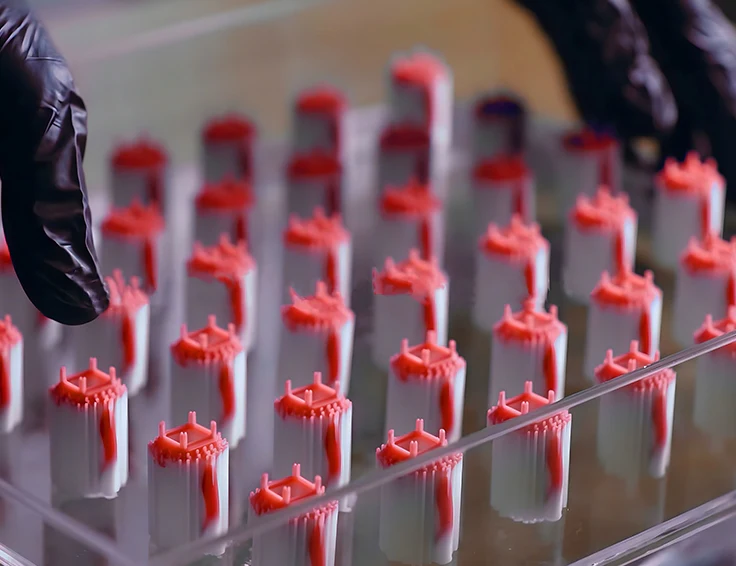 Example of printing with WaxJet – the printing material (wax) is red, alcohol-soluble supports are white.
More articles
Different methods for printing jewelry
3D Printing Market Price for Each Technology
SLS printing
Resin print operating instructions
Types of dental impression
Bambu lab comparison of 3 models
Fusion360
PLA Silk